




Columns
Hazara’s History: Who Were Its Original Inhabitants? Questions Raised by the 1872 Settlement.
04-Oct-2026 — Qazi Jawad
0 Comments
34 Views
اردو میں پڑھیں
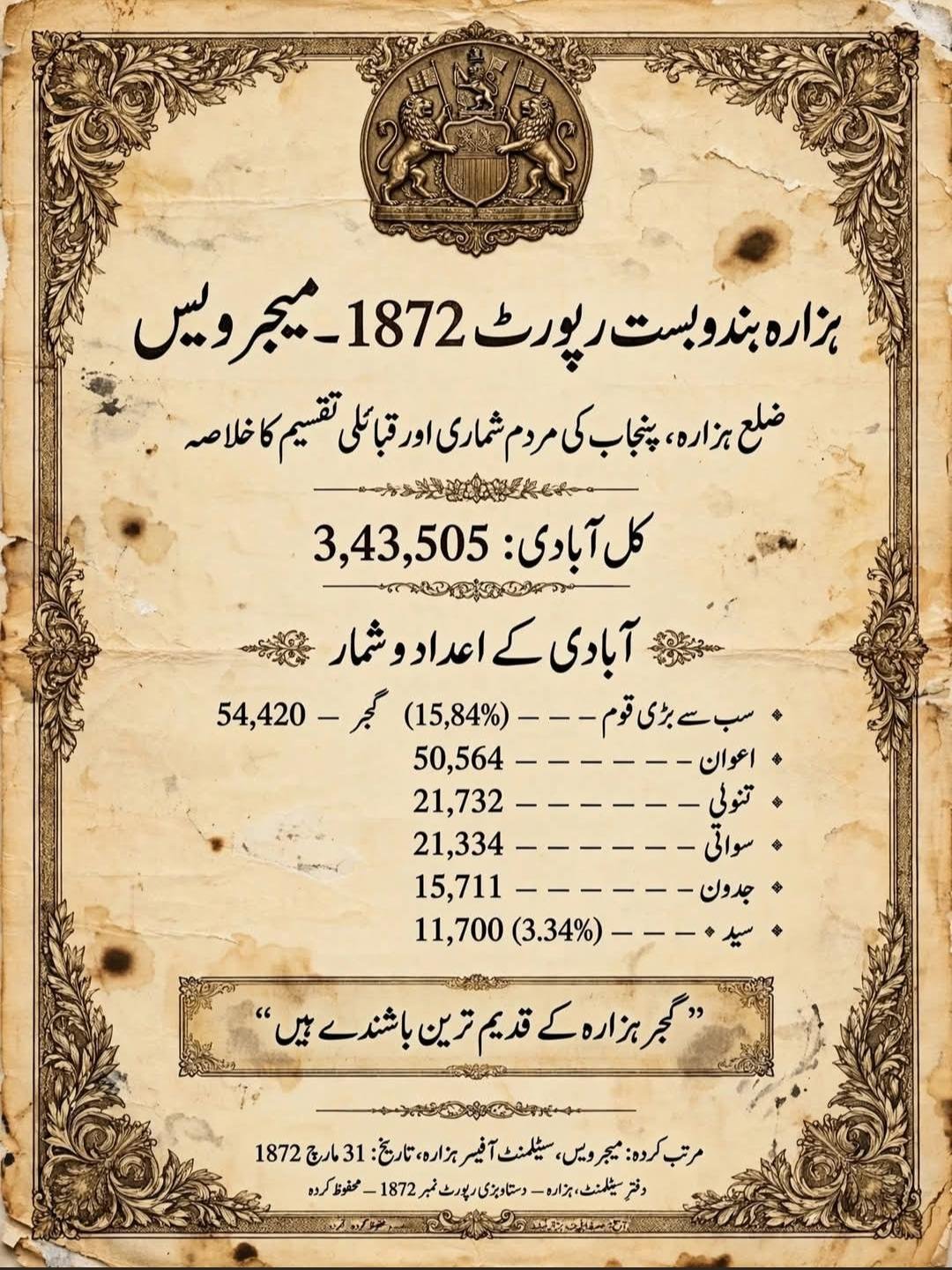
Hazara is a region with a long and complex history shaped by different ruling dynasties, tribes, communities and waves of settlement. The areas that make up present-day Hazara Division—including Mansehra, Abbottabad, Battagram, Haripur and Torghar—have witnessed significant political and social changes over the centuries.
Historical traditions frequently refer to the ancient political region of Hazara as Pakhal Sarkar. Some accounts associate parts of the region with Turkic ruling families, particularly the Karlugh or Karlugh Turks. Historical traditions also describe the arrival of Swati tribes and subsequent changes in political control over Pakhal.
Over time, Hazara became home to a number of communities, including Swatis, Tanolis, Jadoons, Gujjars, Karrals, Sayyids and others. Each community contributed to the social, cultural and economic development of the region. For this reason, describing Hazara’s entire history as belonging exclusively to a single tribe or community oversimplifies a much more complicated historical picture.
In 1849, following the end of Sikh rule, Hazara came under British administration. During the British period, various records were prepared concerning land, population, tribal organization and administrative arrangements. Among these historical records, the 1872 Settlement is frequently cited in discussions about the region’s land and population history.
Some accounts refer to the report associated with Major Wace, claiming that it provides evidence regarding the ancient presence of the Gujjar community in Hazara. Such claims, however, need to be examined through the original settlement records and compared with other contemporary administrative documents and reliable historical sources before firm conclusions can be drawn.
The concept of land ownership in nineteenth-century Hazara was also different from the modern legal understanding of ownership. Tribal influence, local authority, agricultural rights, settlement patterns and administrative arrangements could vary considerably from one area to another. Therefore, determining who was the “original owner” of the entire Hazara region requires careful consideration of the specific historical period and the legal and social system of that time.
One thing remains clear: the history of modern Hazara cannot be attributed to one community alone. Different tribes and families settled in the region over generations and played important roles in shaping its culture, society, economy and political landscape.
History should not be used to create division. Instead, it should help us understand where we came from. A detailed study of the 1872 Settlement, British administrative reports, local historical traditions and other primary documents could provide a clearer understanding of Hazara’s past and the communities that have lived here.
Therefore, the more meaningful question is not simply, “Who owns Hazara?” The real historical questions are: Who lived here during different periods? Who exercised political authority? How were land rights organized? And what role did different communities play in the development of the region?
Hazara’s soil carries the shared history of generations. Understanding that history requires research, documentary evidence and respect for the contributions of all communities rather than claims designed to establish superiority for one group.
Historical Note: Some claims surrounding Hazara’s early settlement, tribal ownership and the 1872 Settlement are based on competing traditions and interpretations. Final conclusions should be drawn only after examining original settlement records, contemporary administrative reports and reliable historical research.
Historical traditions frequently refer to the ancient political region of Hazara as Pakhal Sarkar. Some accounts associate parts of the region with Turkic ruling families, particularly the Karlugh or Karlugh Turks. Historical traditions also describe the arrival of Swati tribes and subsequent changes in political control over Pakhal.
Over time, Hazara became home to a number of communities, including Swatis, Tanolis, Jadoons, Gujjars, Karrals, Sayyids and others. Each community contributed to the social, cultural and economic development of the region. For this reason, describing Hazara’s entire history as belonging exclusively to a single tribe or community oversimplifies a much more complicated historical picture.
In 1849, following the end of Sikh rule, Hazara came under British administration. During the British period, various records were prepared concerning land, population, tribal organization and administrative arrangements. Among these historical records, the 1872 Settlement is frequently cited in discussions about the region’s land and population history.
Some accounts refer to the report associated with Major Wace, claiming that it provides evidence regarding the ancient presence of the Gujjar community in Hazara. Such claims, however, need to be examined through the original settlement records and compared with other contemporary administrative documents and reliable historical sources before firm conclusions can be drawn.
The concept of land ownership in nineteenth-century Hazara was also different from the modern legal understanding of ownership. Tribal influence, local authority, agricultural rights, settlement patterns and administrative arrangements could vary considerably from one area to another. Therefore, determining who was the “original owner” of the entire Hazara region requires careful consideration of the specific historical period and the legal and social system of that time.
One thing remains clear: the history of modern Hazara cannot be attributed to one community alone. Different tribes and families settled in the region over generations and played important roles in shaping its culture, society, economy and political landscape.
History should not be used to create division. Instead, it should help us understand where we came from. A detailed study of the 1872 Settlement, British administrative reports, local historical traditions and other primary documents could provide a clearer understanding of Hazara’s past and the communities that have lived here.
Therefore, the more meaningful question is not simply, “Who owns Hazara?” The real historical questions are: Who lived here during different periods? Who exercised political authority? How were land rights organized? And what role did different communities play in the development of the region?
Hazara’s soil carries the shared history of generations. Understanding that history requires research, documentary evidence and respect for the contributions of all communities rather than claims designed to establish superiority for one group.
Historical Note: Some claims surrounding Hazara’s early settlement, tribal ownership and the 1872 Settlement are based on competing traditions and interpretations. Final conclusions should be drawn only after examining original settlement records, contemporary administrative reports and reliable historical research.

Comments (0)
No comments yet — be the first to comment.
Leave a Comment